Introduction
Choosing the right dedicated development team is about more than finding skilled developers. It is about partnering with a team that understands your business goals, delivers high-quality software, and scales with your growth. As businesses continue to invest in SaaS products, AI solutions, mobile apps, ERP systems, and custom software, many are choosing dedicated development team services for long-term product development and engineering support.
But with so many technology partners available, how do you choose a dedicated development team that fits your project, budget, and long-term vision? This guide covers the key factors to evaluate, common mistakes to avoid, and the steps to hiring a dedicated software development team with confidence.
Meaning of Dedicated Development Team
A dedicated development team is a group of software professionals who work only on your project for a fixed period or long-term engagement. This team may include developers, UI/UX designers, QA testers, project managers, DevOps engineers, and business analysts.
Unlike freelancers who usually work on multiple projects, a dedicated team of developers stays focused on your product. They understand your business, follow your process, and become part of your growth journey.
In simple terms, it feels like having your own in-house team, but without the cost and effort of hiring, training, infrastructure, and HR management.
Unlike traditional outsourcing, a dedicated development team works as an extension of your organization, gaining deeper product knowledge and supporting continuous development as your business grows.
When Does a Business Need a Dedicated Development Team?
Not every software project requires a dedicated team. However, if your project involves long-term development, frequent feature releases, or specialized technical expertise, this engagement model can provide greater flexibility and continuity than traditional hiring or outsourcing.
You should consider hiring a dedicated team when:
- You have a long-term software project
- You want to build a product from scratch
- Your internal team needs extra support
- You need specific technical skills
- You want faster development without hiring full-time employees
- You are scaling your product or business
- You want better control than traditional outsourcing
- You need a remote development team that works consistently
For startups, a dedicated team helps launch products quickly. For enterprises, it helps manage large development needs without increasing internal workload.
Need a Dedicated Development Team for Your Next Project?
Whether you're building a SaaS platform, AI solution, mobile app, ERP system, or custom software, the right team can accelerate development and reduce hiring complexity. Get access to experienced developers who work as an extension of your business.
Dedicated Team vs Staff Augmentation vs Freelancers
Before choosing a dedicated development team, compare it with other popular engagement models. Understanding how dedicated teams differ from staff augmentation and freelancers will help you select the right approach based on your project complexity, internal capabilities, budget, and long-term business goals.
| Hiring Model | Ideal Use Case | Product Knowledge Retention | Management Overhead | Cost Predictability |
|---|---|---|---|---|
| Dedicated Team | Long-term roadmap, SaaS, complex apps | High (Compounds over time) | Low (Managed by vendor) | High (Predictable monthly fee) |
| Staff Augmentation | Filling immediate, internal skill gaps | Medium (Tied to individual) | High (Requires internal PM) | Medium (Hourly rate scale) |
| Freelancers | Isolated tasks, quick MVPs, bug fixes | Low (Transactional approach) | High (Requires direct oversight) | Variable (Project/hourly based) |
A dedicated development team is the best choice for businesses building long-term products that require continuous collaboration, deep product understanding, and predictable delivery. Staff augmentation is better suited for organizations with an established engineering team that needs temporary expertise, while freelancers are ideal for short-term tasks or small projects with limited scope.
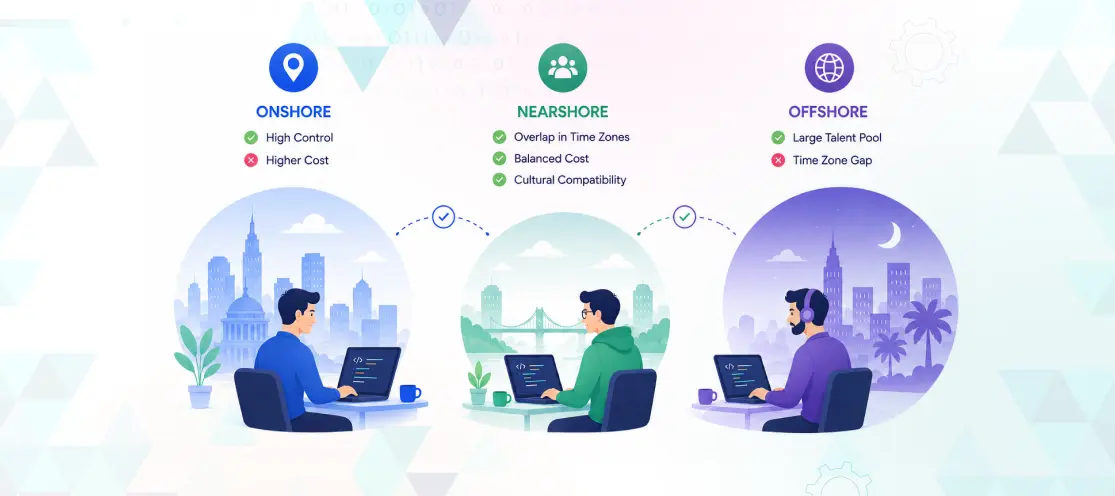
If you're also deciding between different outsourcing approaches, read our guides on Onshore vs. Nearshore vs. Offshore Development and Dedicated Developers vs. Freelancers to understand which engagement model best fits your business needs.
Why Businesses Choose Dedicated Development Teams in 2026
As businesses accelerate digital transformation, the demand for flexible and scalable software development has never been higher. Instead of investing months in recruitment and onboarding, many organizations are choosing dedicated development teams to gain access to experienced professionals who can deliver projects faster while maintaining quality. This engagement model offers the flexibility to scale resources, reduce hiring overhead, and build long-term products with greater confidence.
1. Faster Time-to-Market
A dedicated team is ready to start quickly, helping businesses reduce hiring delays and accelerate product development. This enables faster releases, shorter development cycles, and quicker responses to changing market demands.
2. Access to Specialized Talent
Businesses can work with experienced developers, UI/UX designers, QA engineers, DevOps specialists, and AI experts without the challenges of recruiting each role individually. This ensures the right expertise is available throughout the project.
3. Easy Team Scalability
Project requirements often change as products evolve. A dedicated development team allows businesses to scale resources up or down based on workload without the complexity of hiring or downsizing permanent employees.
4. Better Product Knowledge
Because the team works exclusively on your project, they develop a deep understanding of your product, business goals, and technical architecture. This improves collaboration, reduces onboarding time for future enhancements, and leads to more consistent development.
5. Predictable Costs
Unlike traditional hiring, businesses avoid recruitment expenses, infrastructure costs, employee benefits, and ongoing administrative overhead. Most dedicated team engagement models also provide transparent monthly pricing, making budgeting easier.
6. Long-Term Partnership
A dedicated development team is more than an external vendor. They become an extension of your organization, supporting continuous improvements, feature enhancements, maintenance, and future product growth as your business evolves.
7 Factors to Consider When Choosing a Dedicated Development Team
1. Technical Expertise and Team Availability
Start by evaluating whether the team has the technical expertise required for your project. Look for experience in mobile app development, web development, AI, cloud, DevOps, ERP, or product engineering. Also, ensure they have the right mix of developers, designers, QA engineers, and other specialists based on your project requirements.
Team availability is equally important. A reliable technology partner should be able to onboard skilled developers within a reasonable timeframe without compromising quality. If you're exploring global hiring options, read our guide on countries to hire dedicated developers to understand where businesses are finding top software development talent.
2. Communication and Collaboration
Good communication is one of the most important parts of successful software development. A dedicated software development team should be easy to communicate with. They should give regular updates, join meetings, share progress reports, and ask the right questions.
Before hiring, check:
- Do they work in your preferred time zone?
- Do they use tools like Slack, Jira, Trello, ClickUp, or Teams?
- Will you get a dedicated project manager?
- How often will they share updates?
- How do they handle feedback?
A team may be technically strong, but if communication is poor, the project can easily face delays and confusion.
3. Security and Compliance
When you hire a dedicated development team, you may share business ideas, customer data, product plans, and internal documents. So, security is very important. Ask whether the company follows secure coding practices, data protection rules, NDA agreements, access control, and regular security checks.
If your business is in healthcare, finance, e-commerce, or enterprise software, compliance becomes even more important. A reliable development partner should take security seriously from day one.
Organizations handling sensitive data should also follow secure development practices recommended by OWASP.
4. Development Processes and Methodologies
A good, dedicated team should not work randomly. They should follow a proper development process.
Most modern teams use Agile or Scrum methods. This means they divide the project into smaller parts, work in sprints, test regularly, and improve based on feedback.
Ask about their process:
- How do they plan the project?
- How do they manage tasks?
- How do they test the software?
- How do they handle changes?
- How do they report progress?
A clear process helps avoid delays, misunderstandings, and poor-quality output.
5. Pricing and Engagement Models
Pricing is another important factor when choosing a dedicated development team. The cheapest option is not always the best option. Low-cost teams may look attractive at first, but poor quality, delays, and rework can become expensive later.
Common pricing models include:
- Monthly dedicated team model
- Hourly model
- Fixed-price model
- Full-time equivalent model
- Long-term retainer model
If your project scope is clear and short, a fixed-price model may work. But if your project is long-term or evolving, a dedicated team model is usually better. Always ask for transparent pricing. There should be no hidden charges for project management, communication, replacement, onboarding, or support.
6. Portfolio and Client Success Stories
Before hiring any development partner, check their past work. Look at their case studies, portfolio, industries served, technologies used, and client results. This helps you understand whether they have real experience or just general development knowledge.
Ask questions like:
- Have they built similar products before?
- Which industries have they worked with?
- Can they showcase studies?
- Do they have client testimonials?
- What business results did they deliver?
A strong portfolio gives confidence that the team can handle your project properly.
7. Scalability and Long-Term Support
Your project may start small, but it can grow later. So, choose a partner who can scale the team when needed.
For example, you may start with two developers and later need a designer, QA tester, DevOps engineer, or AI expert. A good, dedicated development team services provider should support this growth smoothly.
Also, check whether they offer long-term support after launch. Software needs updates, bug fixes, performance improvements, security patches, and new features.
The right partner does not disappear after delivery. They stay with you as your product grows.
Red Flags to Avoid When Evaluating Development Partners
Not every company that offers dedicated developers is the right fit. Before making a decision, watch for these warning signs that could lead to delays, poor communication, or unexpected costs.
Avoid partners who:
- Offer unclear or non-transparent pricing
- Promise unrealistic timelines or guaranteed delivery
- Do not share developer profiles or relevant experience
- Have poor communication or slow response times
- Do not provide NDAs, contracts, or clear IP ownership terms
- Avoid discussing security, compliance, or data protection
- Have no case studies, client testimonials, or references
- Do not follow a structured development process
- Cannot explain how they manage project risks or handle developer replacements
- Say "yes" to every requirement without understanding your business goals
- Offer unusually low prices without explaining their quality standards
A reliable development partner will be transparent about their processes, communicate openly, and set realistic expectations from the beginning. Choosing a partner who values long-term collaboration over quick sales can significantly improve your project's success.
Step-by-Step Process for Hiring a Dedicated Development Team
Here is a simple process to hire a dedicated software development team in 2026.
1. Define Your Project Goals
Start with clear, documented objectives. Determine what you are building, who the end-user is, and what core problems the software solves. A high-level business concept is enough to start.
2. Map Out Required Tech Skills
List the precise engineering capabilities required. Identify if your product demands specialized frontend, backend, mobile app development, QA automation, DevOps, or specific AI/ML frameworks.
3. Shortlist Dedicated Agencies
Research and filter potential vendors offering dedicated development team services. Audit their case studies, industry experience, and verified client testimonials to narrow down a list of 3 to 5 candidates.
4. Conduct Team Interviews
Do not rely entirely on executive promises. Directly interview the specific developers, technical architects, or project managers assigned to your account to evaluate their technical competence and communication skills.
5. Initiate a Trial Sprint
Mitigate risk by launching a small pilot project, discovery phase, or a 2-week trial sprint. This directly measures their actual code quality, workflow speed, and daily collaboration habits.
6. Finalize the Legal Contract
Execute comprehensive legal frameworks covering transparent pricing, clear timelines, scalability rights, strict non-disclosure agreements (NDAs), and total IP ownership transfer.
7. Establish Progress Tracking
Maintain active involvement post-onboarding. Attend scheduled weekly synchronization calls, review continuous delivery milestones, and maintain active involvement by attending weekly review meetings, tracking milestones, and providing regular feedback to keep the project aligned with your goals.
Questions to Ask Before Hiring a Dedicated Development Team
Before making your final decision, ask these questions to better evaluate the team's technical expertise, communication process, and long-term support capabilities.
- Have you worked on similar projects before?
- Can I review developer profiles before hiring?
- What technologies does your team specialize in?
- How do you handle communication and reporting?
- Which project management tools do you use?
- What is your pricing model?
- Can I scale the team later?
- How do you protect my data and product idea?
- Do you provide post-launch support?
- What happens if a developer needs to be replaced?
- Can we start with a trial sprint?
- Who will be my main point of contact?
These questions will help you choose a reliable and transparent development partner.
Ready to Build Your Dedicated Development Team?
From selecting the right developers to defining the ideal engagement model, we'll help you build a dedicated team that aligns with your business goals, budget, and delivery timeline.
Conclusion
Choosing the right dedicated development team in 2026 requires more than comparing hourly rates. You need to look at technical skills, communication, security, process, pricing, portfolio, scalability, and long-term support.
The right dedicated software development team can help you build better products, reduce hiring challenges, improve delivery speed, and support your business growth. If you want to hire dedicated teams, choose a partner who understands your vision, communicates clearly, works transparently, and can grow with your business. A strong remote development team is not just a group of developers. It is a long-term growth partner for your digital success.
Author Bio

 as
as