Introduction
Italian businesses evaluating Odoo aren't just investing in a new ERP system-they're investing in a platform that must support local fiscal requirements, electronic invoicing, and long-term business growth. Choosing the right implementation partner is critical, as success depends on accurate localization, industry expertise, and a structured implementation approach rather than software alone.
This guide explains how Odoo is being used across Italy, what distinguishes a reliable Odoo implementation partner, and the key factors to evaluate before starting your ERP project.
Key Takeaways
- Understand how Odoo is being adopted across Italy's leading industries.
- Learn the importance of Italian fiscal localization, including FatturaPA, SDI, and Peppol compliance.
- Compare Odoo partner tiers and understand what they indicate.
- Discover the key factors to evaluate when selecting an Odoo implementation partner.
- Learn how to identify a partner that can support your business beyond the initial implementation.
Why Italian Companies Are Investing in Odoo ERP
Businesses across Italy are adopting Odoo to unify accounting, sales, inventory, manufacturing, CRM, and warehouse operations within a single ERP platform. Its modular architecture allows companies to implement the functionality they need today and expand as their business grows, making Odoo a practical and scalable choice for Italian SMEs.
Another key driver is regulatory compliance. Italian businesses must meet electronic invoicing requirements through FatturaPA and the Sistema di Interscambio (SDI), while many also require Peppol support for cross-border transactions. An experienced Odoo implementation partner can configure these local requirements correctly from the outset, reducing compliance risks and simplifying day-to-day operations.
Which Industries Are Driving Odoo Adoption in Italy
Odoo is widely used across Italy, particularly in industries that require integrated operations, inventory management, and financial control. The strongest adoption is seen in:
1. Manufacturing and Mechanical Engineering
Manufacturers use Odoo to manage production planning, Bills of Materials (BOM), inventory, quality control, and shop-floor operations, making it a popular choice for Italy's engineering and automotive sectors.
2. Wholesale and Distribution
Distributors rely on Odoo to manage multi-warehouse inventory, purchasing, sales, and cross-border trade while improving stock visibility across the supply chain.
3. IT Services and Consulting
IT companies use Odoo's CRM, Project, Helpdesk, and Timesheet modules to manage client projects, billable hours, and service delivery from a single platform.
4. Retail and eCommerce
Retailers integrate Point of Sale, inventory, and online stores to keep products, orders, and customer data synchronized across every sales channel.
5. Professional and Legal Services
Consultancies, legal firms, and professional service providers use Odoo to manage accounting, timesheets, recurring billing, document management, and customer relationships.
Businesses in these industries benefit most from working with an Odoo implementation partner that understands their operational workflows and industry-specific requirements.
Odoo Usage by Region: Where the Demand is Concentrated
Odoo adoption in Italy tracks the country's industrial geography closely.
| Region / City | Why Odoo Demand Is Strong |
|---|---|
| Milan & Lombardy | Italy's financial and corporate hub, with a dense concentration of distribution, retail, and professional services firms needing multi-entity ERP setups. |
| Turin | Automotive and mechanical engineering supply chains driving demand for manufacturing and BOM-heavy Odoo configurations. |
| Bologna | Part of the "Motor Valley" and packaging machinery corridor, with strong manufacturing and export-oriented distribution needs. |
| Veneto & Venice | A dense base of export-focused manufacturing SMEs requiring multi-warehouse and multi-currency capability. |
| Rome | A mix of professional services, IT consulting, and public-sector-adjacent organizations needing project and billing management. |
If you're searching for "Odoo Milano," "Odoo Torino," or "Odoo partner Veneto," this regional concentration is why: the demand follows Italy's existing industrial and commercial clusters, not the other way around.
Planning an Odoo implementation in Italy?
A short discovery session can help identify localization requirements, implementation scope, and potential project risks before development begins.
What Actually Makes an Odoo Partner "the Best" in Italy
Odoo's own partner directory lists dozens of resellers active in Italy, but only a small fraction hold Gold certification, and certification tier alone doesn't tell you whether a partner will deliver a stable, compliant, well-supported system. Before selecting a partner, evaluate them against these criteria:
| Criterion | Why It Matters |
|---|---|
| Official Odoo certification (Ready / Silver / Gold) | Confirms a baseline of trained consultants and access to Odoo's official support channels. |
| Vertical experience in your industry | A partner who has configured manufacturing BOMs or multi-warehouse logistics before will avoid costly reconfiguration later. |
| Italian fiscal localization expertise | The partner must correctly configure FatturaPA, SDI destination codes, reverse-charge tax grids, and Peppol cross-border invoicing, not just install the base localization module. |
| Data migration methodology | Ask how they validate migrated data before go-live; unvalidated migrations are the single biggest source of post-launch chaos. |
| Post-launch support model | Confirm response times, whether support is a fixed retainer or ad hoc, and who handles version upgrades. |
| Transparent, scoped pricing | Fixed-scope implementation quotes with clearly defined change-request terms protect you from budget creep. |
| Communication and time-zone overlap | Whether local or remote, the team needs working hours that align with yours for daily decision-making during the project. |
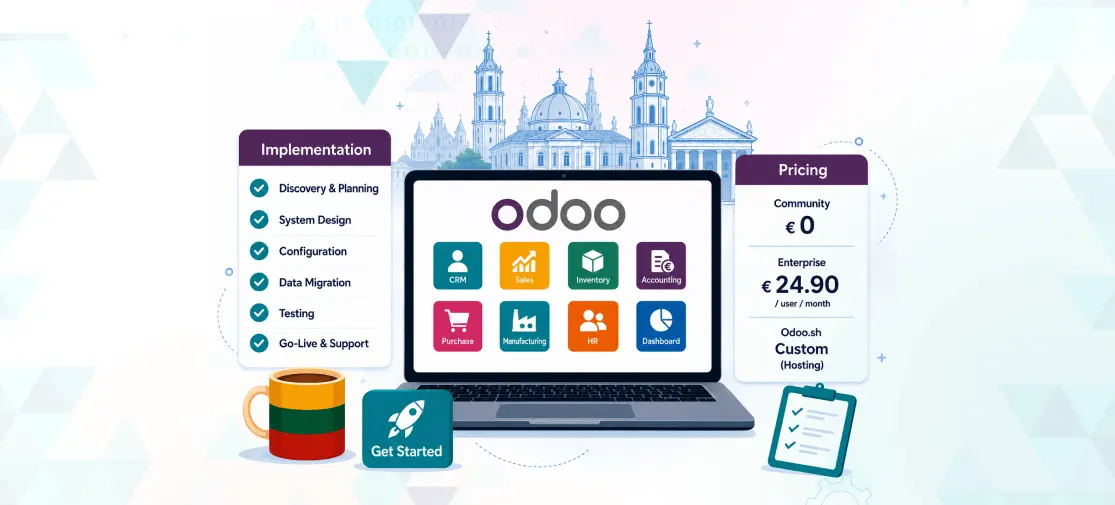
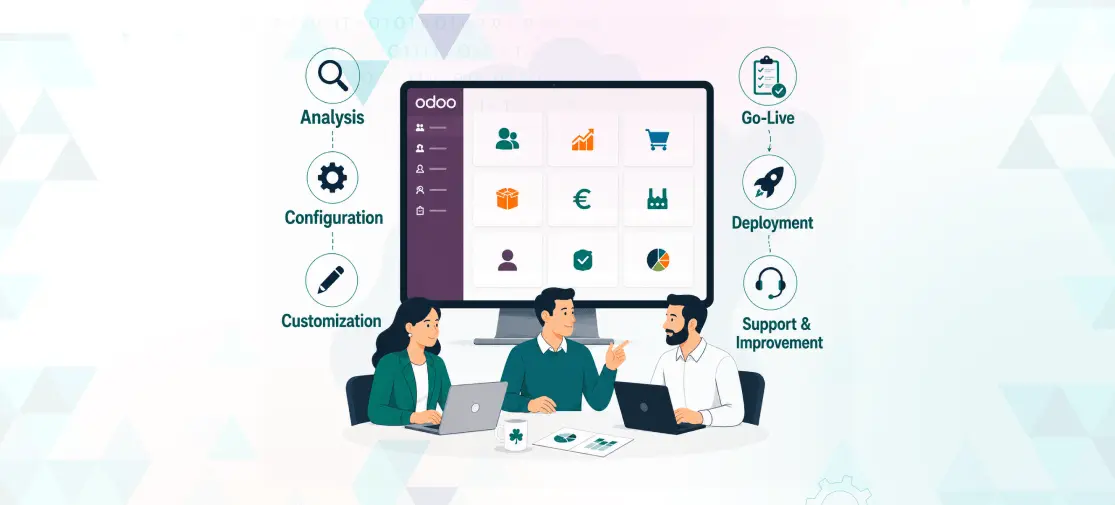
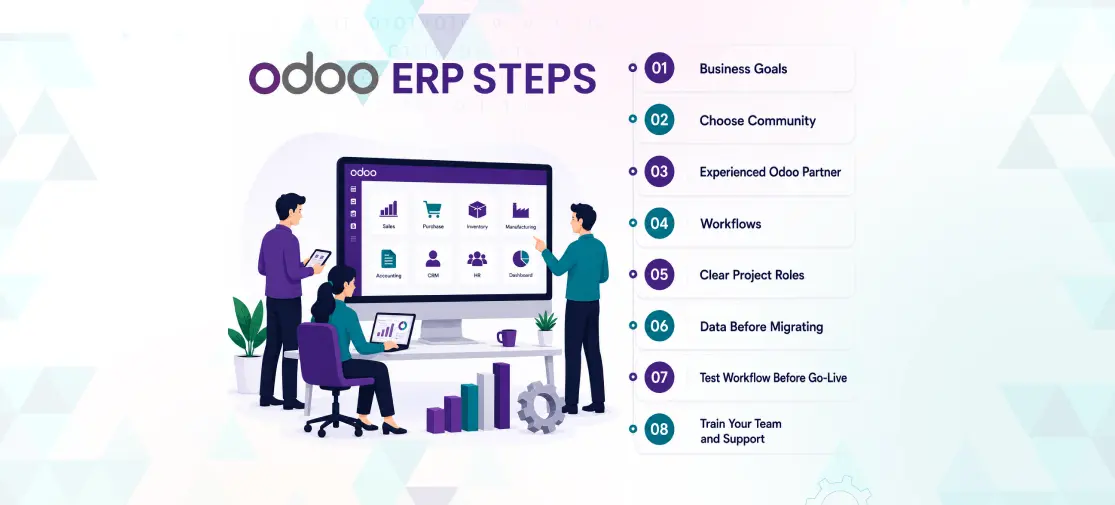
How a Professional Odoo Implementation Actually Runs
A reliable Odoo engagement in Italy follows a structured sequence, regardless of company size:
- Discovery and process mapping - documenting current workflows across sales, inventory, finance, and any department-specific processes before touching configuration.
- Gap analysis and module selection - matching business requirements to Odoo's native apps and identifying where custom development is genuinely required versus where standard configuration suffices.
- Configuration and customization - setting up the Italian fiscal position, tax grids, and any custom modules or workflow logic specific to the business.
- Data migration and validation - importing customers, products, and historical accounting data, then reconciling it against the legacy system before cutover.
- Testing and user acceptance - running realistic transaction scenarios with actual users before go-live, not just administrator walkthroughs.
- Training - role-specific training so warehouse staff, accountants, and sales teams each learn the parts of the system relevant to their work.
- Go-live and hypercare - a defined period of close support immediately after launch, when issues are most likely to surface.
- Ongoing support and upgrades - a support agreement covering bug fixes, minor enhancements, and version upgrade planning.
Partners who skip steps 1, 2, or 4 tend to produce systems that "technically work" but don't match how the business actually operates, which is the most common cause of low user adoption after launch.
Common Odoo Project Risks in Italy and How the Right Partner Prevents Them
- E-invoicing misconfiguration. Incorrect SdI destination codes or tax exemption codes (Natura) can cause rejected invoices at scale. A partner with genuine Italian localization experience catches this during configuration, not after the first rejected batch.
- Over-customization. Heavily customized modules that deviate from Odoo's core architecture become expensive to maintain and complicate future upgrades. Experienced partners default to configuration over custom code wherever possible.
- Unvalidated data migration. Moving data without reconciliation checks often surfaces as missing stock quantities or broken customer records weeks after go-live, when they're harder to trace.
- No clear support agreement. Some implementations end abruptly at go-live, leaving the business without a defined path for bug fixes or upgrades. Always confirm what happens after launch before signing.
- Vendor lock-in through poor documentation. If a partner doesn't document custom modules and configuration decisions, switching providers later becomes disproportionately expensive.
Ready to Start Your Odoo Project?
Whether you're implementing Odoo for the first time or replacing an existing ERP, our certified Odoo consultants can help you plan the right implementation strategy for your business.
Why Consider Techvoot for Your Odoo Implementation
Techvoot is an official Odoo partner providing end-to-end Odoo implementation services, including business process analysis, customization, data migration, third-party integrations, user training, and ongoing support. With experience across manufacturing, wholesale, retail, logistics, and professional services, the team helps businesses implement Odoo in line with their operational requirements and long-term growth objectives.
For Italian businesses, Techvoot also supports ERP implementations requiring industry-specific customization and Italian fiscal localization, helping organizations streamline operations while maintaining compliance with local business requirements.
For Italian businesses, this means:
- End-to-end Odoo implementation, customization, migration, integration, and support.
- Certified functional consultants and developers with experience across manufacturing, distribution, retail, and services.
- Proven experience with Italian fiscal localization, including FatturaPA and SDI configuration.
- Flexible remote delivery with dedicated support during European business hours.
FAQ
Who is the best Odoo partner in Italy?
The best Odoo partner in Italy depends on your industry, project complexity, and business requirements. Look beyond certification levels and evaluate partners based on their implementation experience, Italian fiscal localization expertise, customer references, and post-launch support.
How much does an Odoo implementation cost in Italy?
The cost of an Odoo implementation varies depending on the number of users, modules, customizations, integrations, and data migration requirements. Before comparing quotes, request a detailed project scope that clearly defines deliverables, timelines, and support services.
Is Odoo compliant with Italian e-invoicing requirements?
Yes. Odoo supports Italian electronic invoicing through FatturaPA and the Sistema di Interscambio (SDI), with additional support for Peppol. Proper configuration of tax codes, destination codes, and fiscal localization should be handled by an experienced implementation partner.
How long does an Odoo implementation take?
Implementation timelines depend on your business size and project scope. Smaller deployments can often be completed within a few weeks, while larger manufacturing or multi-company implementations typically require additional time for customization, testing, and user training.
Can Odoo be customized for specific industries?
Yes. Odoo's modular architecture supports industry-specific workflows, custom modules, and integrations for sectors such as manufacturing, wholesale distribution, retail, professional services, and healthcare while remaining scalable as your business grows.
Does my Odoo implementation partner need to be based in Italy?
Not necessarily. What's most important is choosing a partner with proven experience in Italian fiscal localization, compliance requirements, and reliable communication during your business hours. Many Italian companies successfully work with certified international Odoo partners through remote delivery.
Author Bio

 as
as