Introduction
As businesses across Ireland modernize their operations with integrated ERP solutions, choosing the right Odoo partner has become a strategic business decision. A successful Odoo implementation depends not only on the platform itself but also on the expertise and experience of the implementation partner.
This guide covers the key factors to evaluate before choosing an Odoo implementation partner, along with industry insights, local considerations, and practical advice to help you make an informed decision.
Why More Irish Businesses Are Searching for Odoo Partners
The demand for Odoo partners in Ireland has grown significantly as businesses modernize their operations, adapt to evolving regulations, and look for more cost-effective ERP solutions. Several factors are driving this shift.
1. Evolving E-Invoicing and Compliance Requirements
Ireland is preparing for wider adoption of structured e-invoicing under the EU's VAT in the Digital Age (ViDA) initiative, with the Peppol network expected to play an increasingly important role. Businesses are proactively upgrading their ERP systems to support digital invoicing, VAT reporting, and future compliance requirements rather than waiting for regulatory deadlines.
2. Rising Operational Costs
Increasing labour costs, software licensing fees, and inflation have encouraged many SMEs to reassess expensive legacy ERP platforms. Odoo's modular approach allows businesses to implement only the applications they need while keeping long-term ownership costs under control.
3. Replacing Disconnected Business Systems
Many Irish businesses still manage finance, inventory, CRM, sales, and purchasing across multiple applications and spreadsheets. As operations grow, disconnected systems create duplicate work, inconsistent data, and limited visibility into business performance. Implementing Odoo enables organizations to centralize these processes within a single integrated platform.
These trends don't automatically make Odoo the right solution for every business. However, they do highlight why selecting an experienced Odoo implementation partner has become increasingly important for organizations planning their digital transformation.
What Defines the Best Odoo Partner in Ireland?
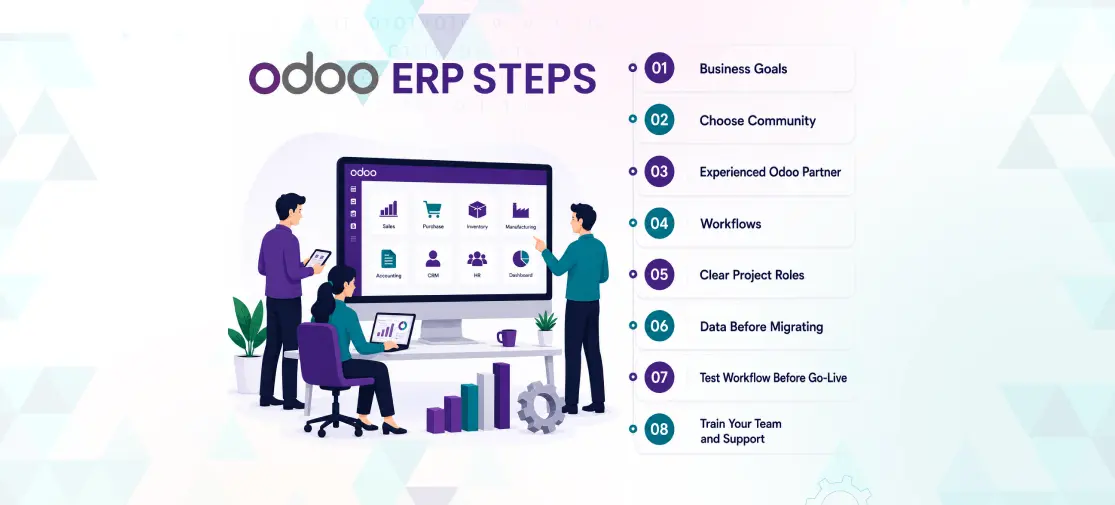
Choosing the best Odoo partner isn't just about certification levels such as Ready, Silver, or Gold. A successful ERP implementation depends on the partner's ability to understand your business, configure Odoo correctly, and provide long-term support.
- Knowledge of Irish Business Requirements: Your partner should understand Irish VAT, ROS integration, Relevant Contracts Tax (RCT) where applicable, and financial reporting requirements to ensure a compliant implementation.
- Industry Experience: Partners with experience in your industry can configure workflows, modules, and business processes more efficiently, reducing implementation risks and accelerating time to value.
- Post-Go-Live Support: Odoo continues to evolve after implementation. Choose a partner that offers ongoing support, system optimization, training, and enhancements as your business grows.
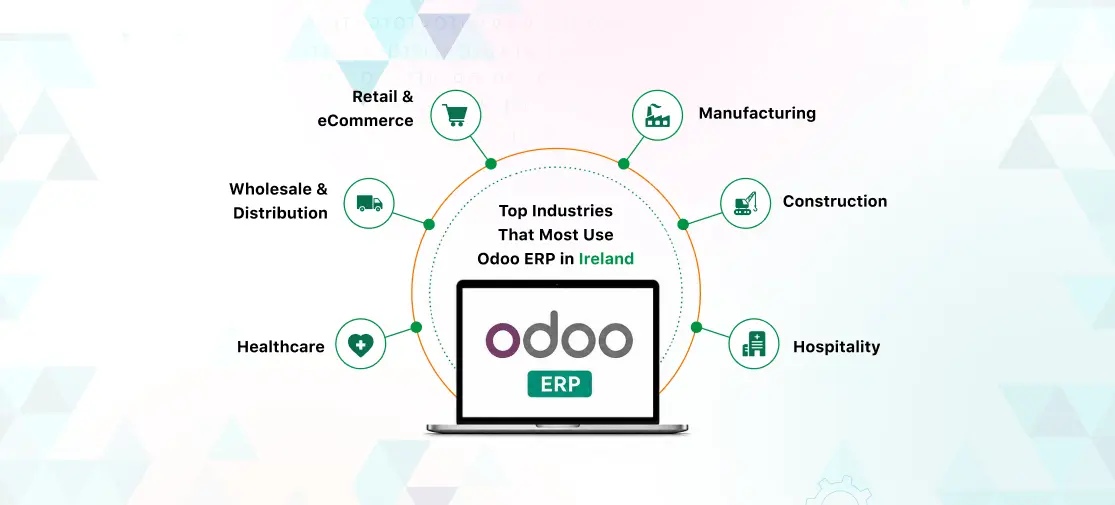
Industries That Benefit Most from Odoo in Ireland
Odoo is widely adopted across Ireland because its modular architecture supports businesses of different sizes and industries. While every implementation is unique, these sectors commonly use Odoo to streamline operations and improve business visibility.
1. Manufacturing & Engineering
Manufacturers use Odoo to manage production planning, bills of materials (BOM), work orders, quality control, and inventory. An experienced implementation partner can configure these workflows to improve production efficiency and reduce manual processes.
2. Wholesale, Distribution & E-commerce
Businesses in wholesale and distribution rely on Odoo for inventory management, multi-warehouse operations, automated purchasing, order fulfillment, and seamless integration with e-commerce platforms, helping maintain accurate stock levels across multiple sales channels.
3. Professional Services & IT
Consulting firms, software companies, and service providers use Odoo to centralize CRM, project management, timesheets, resource planning, and client invoicing, giving teams better visibility into project performance and profitability.
4. Food, Beverage & Pharmaceuticals
Companies operating in regulated industries benefit from Odoo's lot tracking, batch traceability, expiry management, and quality controls, helping meet operational and compliance requirements while maintaining product traceability.
5. Construction & Property Management
Construction businesses use Odoo for project costing, procurement, subcontractor management, field service operations, and financial tracking, enabling better control over project budgets and resource allocation.
Where Odoo Adoption is Growing in Ireland
Odoo adoption is increasing across Ireland as businesses modernize their operations and replace disconnected systems with integrated ERP solutions. Dublin remains the largest market, driven by technology companies, professional services, and wholesale businesses.
Cork has seen strong adoption among manufacturing and pharmaceutical organizations, while Limerick and Galway continue to grow with engineering firms, regional distributors, and mid-sized manufacturers embracing digital transformation.
Businesses operating across both Ireland and Northern Ireland often require additional ERP capabilities, including multi-currency support, cross-border taxation, and UK/EU VAT compliance. Working with an experienced Odoo implementation partner helps ensure these requirements are configured correctly from the outset.
Why Many Irish SMEs Choose Odoo Over SAP, NetSuite, or Sage
For many small and mid-sized businesses in Ireland, Odoo offers a practical balance of functionality, flexibility, and affordability. Its modular architecture allows organizations to start with the applications they need and expand as their operations grow, making it an attractive alternative to larger ERP platforms.
| Factor | Odoo | SAP / NetSuite / Sage |
|---|---|---|
| Deployment | Modular platform that grows with your business | Often requires broader implementation from the outset |
| Licensing | Flexible pricing based on selected applications and users | Licensing models vary and can become more expensive as functionality expands |
| Customization | Open architecture with extensive customization options | Customizations may depend on vendor-specific frameworks and licensing |
| Ease of Use | Modern, intuitive interface with faster user adoption | May require more extensive user training depending on the platform |
| Scalability | Suitable for startups, SMEs, and growing businesses | Often preferred for large enterprises with highly complex operations |
For Irish SMEs that need integrated accounting, CRM, inventory, manufacturing, sales, purchasing, and project management without the complexity of a large enterprise ERP, Odoo provides a flexible platform that can scale alongside business growth. Choosing the right implementation partner is equally important, ensuring the system is configured to match operational processes and future expansion plans.
The Part Most Odoo Content Skips
Two things are reshaping what a "good" Odoo implementation looks like in 2026, and most partner websites still don't address either one properly.
1. AI, Automation & E-Invoicing Readiness
Modern Odoo implementations are no longer limited to ERP configuration alone. Businesses are increasingly looking for solutions that combine process automation, AI capabilities, and compliance with evolving digital invoicing requirements. When evaluating an Odoo partner, these areas deserve as much attention as the core implementation itself.
2. AI-Powered Business Automation
Odoo supports a growing range of AI-enabled capabilities, from intelligent document processing and invoice automation to predictive inventory planning, CRM lead scoring, and business forecasting. An implementation partner with expertise in both Odoo and AI can help businesses automate routine processes and generate deeper operational insights, maximizing the long-term value of the platform.
3. Peppol and E-Invoicing Compliance
As Ireland moves toward broader adoption of structured e-invoicing under the EU's VAT in the Digital Age (ViDA) initiative, businesses should ensure their ERP system is prepared for future compliance requirements. Odoo supports Peppol-compatible XML/UBL formats, but successful implementation depends on proper configuration, integration, and localization from the outset.
Choosing a partner with expertise in ERP implementation, business automation, and AI integration helps ensure your Odoo platform is not only compliant today but also ready to support future operational and regulatory requirements.
Red Flags to Watch for When Choosing an Odoo Partner
Not every Odoo implementation partner offers the same level of expertise or long-term support. Watch for these common warning signs during the evaluation process:
- Pricing based only on user count without first understanding your business processes, workflows, and implementation goals.
- Limited knowledge of Irish compliance, including VAT, ROS, RCT, or Peppol e-invoicing requirements.
- No proven experience in your industry or an inability to share relevant implementation case studies or client references.
- Lack of post-implementation support, with no defined Service Level Agreement (SLA), training plan, or ongoing optimization services.
- Poor communication or limited support availability, especially if support teams have little overlap with Irish business hours.
- A one-size-fits-all implementation approach, rather than tailoring Odoo modules and workflows to your business requirements.
Choosing a partner that understands your industry, business objectives, and long-term growth strategy helps reduce implementation risks and improves the likelihood of a successful Odoo deployment.
Where Techvoot Solutions Fits
Techvoot Solutions is an official Odoo Partner specializing in implementation, customization, migration, and support for businesses across manufacturing, distribution, logistics, healthcare, retail, and construction. Our team combines certified Odoo developers and functional consultants to deliver ERP solutions tailored to each organization's operational requirements.
Beyond standard Odoo implementation, we help businesses extend the platform through custom module development, third-party integrations, workflow automation, and AI-powered solutions. This enables organizations to streamline operations, improve decision-making, and prepare for future business growth.
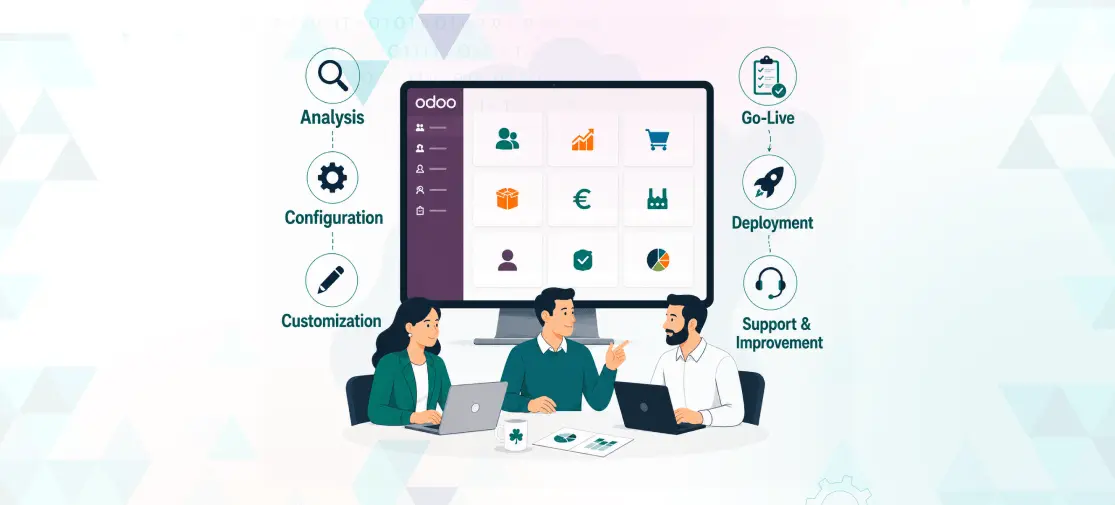
Our implementation approach includes business process discovery, solution design, data migration, system configuration, user training, testing, and post-go-live support. For businesses operating in Ireland, we also configure Odoo to align with local business requirements, including VAT, ROS, RCT (where applicable), and evolving e-invoicing standards, helping ensure a smooth and compliant implementation.
Getting Started
Choosing the right Odoo partner in Ireland is about more than certifications or pricing. It requires a team that understands your industry, business processes, compliance requirements, and long-term growth objectives. The right implementation partner will help you maximize the value of your ERP investment while ensuring your system remains scalable as your business evolves.
If you're planning an Odoo implementation, migration, or customization project, Techvoot Solutions can help you evaluate your requirements, recommend the right modules, and build an implementation roadmap tailored to your business. Contact our team to discuss your project and explore how Odoo can support your digital transformation.
FAQ
Is Odoo suitable for small businesses in Ireland?
Yes. Odoo is designed for businesses of all sizes. Its modular architecture allows small businesses to start with applications such as CRM or Accounting and add Inventory, Sales, Manufacturing, or HR as their operations grow.
How much does Odoo implementation cost in Ireland?
The cost depends on the number of users, required modules, customization, integrations, and data migration. While Odoo licensing is subscription-based, implementation costs vary depending on project complexity, making it important to discuss your requirements with an experienced Odoo partner.
Does Odoo support Irish VAT and Revenue requirements?
Yes. Odoo can be configured to support Irish VAT, Revenue Online Service (ROS) requirements, and Relevant Contracts Tax (RCT) where applicable. Proper localization during implementation is essential to ensure compliance and accurate financial reporting.
How long does an Odoo implementation take?
Implementation timelines vary depending on business size and project scope. A standard SME implementation typically takes between 6 and 10 weeks, while larger multi-company or highly customized deployments may require several months.
Is Odoo ready for Ireland's e-invoicing requirements?
Yes. Odoo supports Peppol-compatible XML/UBL formats and can be configured to meet evolving e-invoicing requirements under the EU's VAT in the Digital Age (ViDA) initiative. Working with an experienced implementation partner helps ensure these capabilities are configured correctly.
Can Odoo integrate with existing business applications?
Yes. Odoo integrates with a wide range of third-party systems, including eCommerce platforms, payment gateways, accounting software, logistics providers, and custom business applications through APIs and custom integrations.
Can Odoo be customized for my industry?
Absolutely. Odoo's modular architecture allows businesses to customize workflows, reports, dashboards, and business processes to match industry-specific requirements across manufacturing, healthcare, retail, logistics, construction, professional services, and more.
What should I look for when choosing an Odoo partner in Ireland?
Look for an official Odoo Partner with proven implementation experience, industry expertise, knowledge of Irish business requirements, a structured implementation methodology, and reliable post-go-live support.
Author Bio

 as
as